
We take a look at the What’s and the Why’s of pervious paving.

L: Pervious concrete bears an uncanny resemblance to Rice Krispies Treats; R: Water flows through pervious concrete designed for cold weather climates. Photos: L: Low Impact Developing; R: US Concrete.
What is Pervious?
A true definition of pervious (also porous or permeable) paving is hard to come by, but it essentially refers to a surface that accommodates foot or vehicle traffic and is more porous than traditional non-porous concrete or asphalt paving.
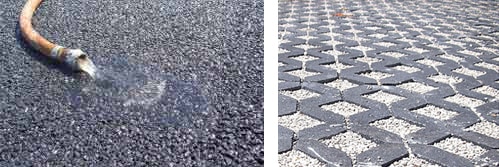
L: Water is absorbed by a porous asphalt pavement; R: Permeable pavers from The Enhance Companies in Turfstone. Photos: L: Alaniz Construction, Inc.; R: The Enhance Companies.
How does it work?
Pervious paving is based on the principle of allowing water to pass through a paved surface rather than flow off of it. Some manufacturers like Permapave offer pavers made of graded aggregates that are bound together in a way that leaves voids for water to drain through. Others, like Grasscrete, use an impervious substance like concrete in an open configuration to allow grass, peastone, or other pervious materials to fill in the voids. Porous asphalt, which is used in road paving (as in all new Oregon and Georgia interstate highways), consists of an open-graded asphalt mix over an 18-36″ uniformly-graded crushed stone recharge bed. Porous asphalt is made from the same materials as conventional asphalt (either petroleum industry byproduct or natural deposits) but uses an asphalt mix with fewer fine components and greater permeability, necessitating a different structure underneath. Pervious concrete can also be used for roads, differing from conventional concrete in that it is made of smaller stones and little or no sand to let water through. All of these options require a significant sub-base and uncompacted sub-grade underneath to maintain the stability of the paving, as well as consideration of the type of traffic (foot or vehicle), frequency, and weight load to determine the best paving option.

L: A cross-section of permeable paving structure; R: Permapave permeable pavers in Hunter River Wash. Illustration: North Shore City.; Photo: Permapave.
Benefits of Pervious Paving:
- Management of stormwater runoff: By allowing excess water to drain through a paved surface instead of running into catchbasins and inlets, runoff is slowed and there is a reduction in cost for piping and other utilities required in traditional stormwater management systems.

L: Grasscrete pavers; R: Another grass paving option. Photos: L: Pavingexpert.com; R: Equity Green.
- Filtration of polluted stormwater: In areas that need to be paved to accommodate pedestrian and vehicular traffic, the layers that make up a pervious paving system (typically the surface, sub-base, and sub-grade) act as soil would to filter and break down oils and other toxins washed away by stormwater before these reach groundwater systems. The depth of these layers ensures that contaminated water comes into contact with a great deal of sub-base before infiltrating the soil below.
- Mitigation of the heat island effect using porous asphalt: Conventional non-porous asphalt absorbs solar radiation, contributing to higher temperatures in heavily-paved metropolitan areas. Less heat-trapping material is used to create the open structure of porous asphalt pavements, leading to measurably lower night-time surface temperatures.

L: “Grasscrete” filled with colored sea glass; R: A colored pervious concrete installation by Bunyan Industries of Salt Lake City. Photos: L: Equity Green; R: Bunyan Industries.
- Addition of aesthetic value: Some pervious paving systems that rely on a pattern of closed and open surfaces allow you to customize the look of your paving by adding grass, peastone, decorative aggregates, or bark mulch, to add green space, color and texture.
- Improvement of driving conditions: porous asphalt roads are said to reduce the incidence of hydroplaning by allowing water to drain through, as well as muffle traffic noise.

L: Finding driveway inspiration in Hawaii; R: A city driveway goes “country lane.” Photos: L: flickr: Sandeep_8; R: LA Team Effort.
For homeowners, another way to reduce the amount of pervious paving around your home is to just pave less, as in the driveways above!
In other news, thanks to you, our readers, The Home Outside has been selected as one of the 40 Top Landscaping Blogs for 2010! Thank you for being a part of the growth of our blog.





Great post, Julie. We have also recently installed Eagle Bay SF Rima for a below-street-grade parking forecourt/drive loop in front of a home in Charlottesville; we eliminated lawn, made more room for cars to circulate, and created a surface that is at once more ‘dressy’ than asphalt at the front door (party overflow surface) and more ‘green’. Stormwater is held beneath and then slowly infiltrated down a slope with plantings.
Very informative post. I very much like the green aspect of permeable paving, but find it a hard sell in Western New York. The commercial installations used to show the merits of the product are often not well maintained, either with grass infill or gravel. It is catching on, but at a slower pace than elsewhere.
I just completed a class project in which we specified the new architectural pervious concrete by StoneyCreek called Stoneycrete. Seems to be less “chucky” than the generic pervious concrete.
Good work Julie… I am doing a training in landscape designing and landscape construction. Your information would be very helpful to me.. Thanks
Ana & Val, thank you for this great information. We do a ton of repairs on decks, patios, walkways and such down here in South Florida due to all the rainwater, moving sand and ground and all the harsh elements taking their toll on beautiful designs. I really loved reading about your ideas and expertise. Great stuff!
This was really interesting. Thank you for the great article. I’ll be back for more!
I just had an entire new patio installed with brick pavers and because I live in Florida with tons of rain, it is already starting to become uneven and pavers are lifting up. In fact, many of them are popping up and we are tripping on them. It seems like the company that installed them had no idea what they were doing. What can we do to make them even again?
Without taking a look on site at your property, it’s hard to say what’s going on with certainty. Generally speaking though, if you’re certain water is the issue, a well-compacted base of crushed stone should allow water to freely move under your patio and prevent significant movement of the pavers. If you don’t want to hire a contractor to perform a wholesale resetting of the patio and examination of the base material, we would recommend resetting the pavers by hand that are most uneven, and just leave the rest (perhaps considering the uneven pavers part of the “unique character” of your patio). You could also see if there’s a way to divert stormwater runoff away from your patio, to reduce future water movement under the patio and hopefully future movement of the individual pavers themselves. Good luck!
I’ve heard these pavers do great work. I honestly really like this design. Fun read.